As it is commonly known that the past shapes Chinese cultural production, ancient Chinese collectors were known for obtaining valuable objects essential to the Chinese materialistic culture. More specifically, objects included “bronzes and jades from the period up to the Han dynasty, certain types of ceramics from the Song period, and the special category of calligraphy and paintings from any era” (93). Not only were the vases of jade, bronze, and clay highly valued, but paintings made in ink were as well.
The majority of ceramics dated from the Song period. They were typically classified by ‘wares’. For example, “‘Guan ware’ is literally ‘Official ware’, supposedly manufactured in kilns under direct imperial control at the Southern Song capital of Hangzhou in Zhejiang province” and fancier ones included “‘Ge ware’, literally ‘Elder brother ware’, from a picturesque anecdote about a family of potters” (102). Certain types of ‘ware’ were characterized as “ancient” in order to differentiate them for the contemporary objects that were being produced (102). Not only was I intrigued by the labeling process, but the different contexts of the ceramic types that were known for having a positive or negative connotation. While the white porcelain of Dingzhou was known for having a positive context, the ceramic seals were known to lack any sort of worth.
I chose to analyze the “Jar with Dragon” from 14th century China. This piece of porcelain from the Xuande period is painted with cobalt blue and has a transparent glaze. The painting on the jar “depicts a powerful dragon undulating through a sky defined by a few sparse clouds.” As this piece is porcelain, it is likely that it would be considered to have a positive connotation by Ming period buyers. It would also be noted that its medium is Jingdezhen ware which provides insight into its origination. The “Jar with Dragon” is an antique piece that the Ming period buyers would find of great interest and be curious as to how its Indo-Himalayan imagery was significant in history.
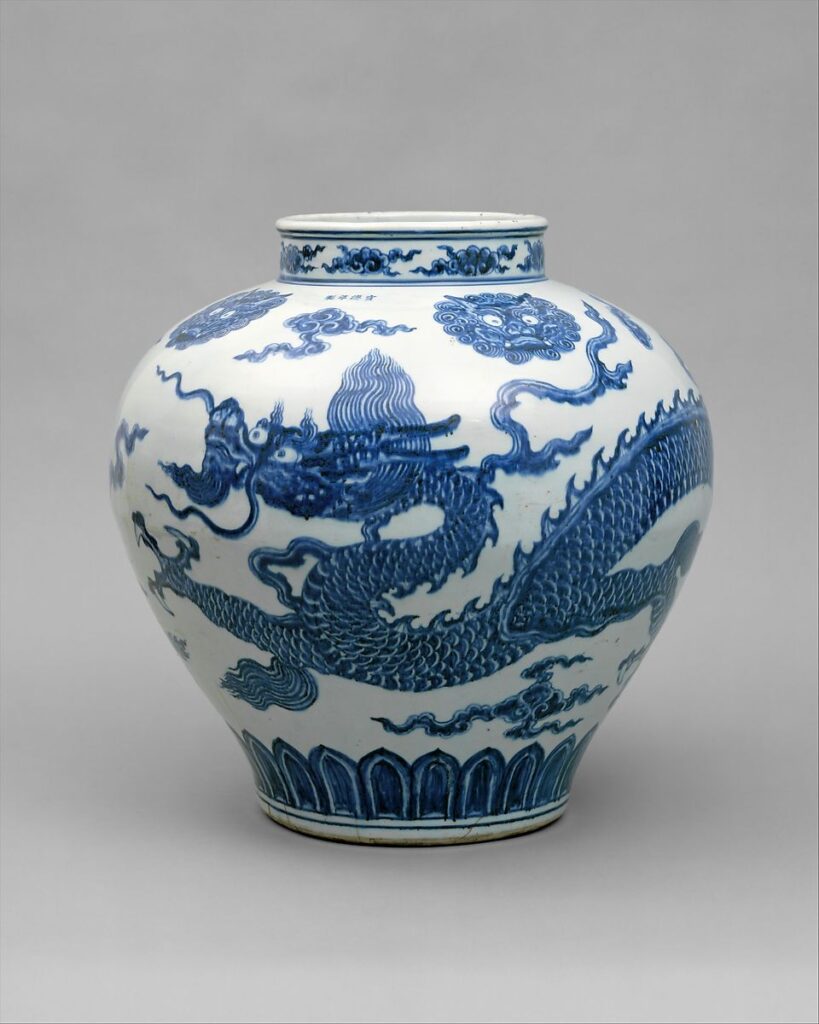
https://www.metmuseum.org/art/collection/search/39666
Works Cited
Clunas, Craig. Superfluous Things: Material Culture and Social Status in Early Modern China. Honolulu: Univ Of Hawai’i Press, 2016.
