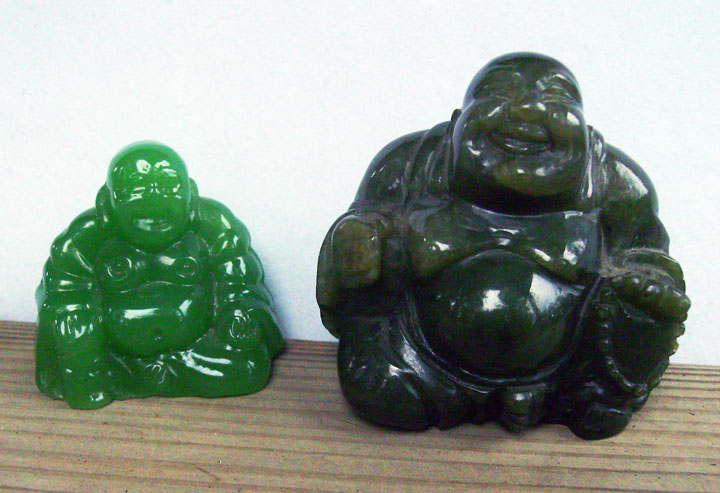
As a fashionable gemstone known for its rich heritage, jade has held a special place in Chinese history. Known for its aesthetic beauty, as well as its practical use and social value, jade is significant to many cultures, especially that of ancient Central America.[1] The Chinese definition of jade, “yu,” translates to “any stone suitable for carving” which demonstrates how it was laboriously carved and polished into a variety of objects ranging from personal ornaments to objects for ritual and ceremonial purposes, as well as for burials.[2] This unique gemstone is characterized by its extraordinary color combinations and extreme toughness. Jade was classified as either nephrite, known as traditional jade, or jadeite, introduced in the late 18th century. While the most significant jade mines are located in northern Burma, known as modern Myanmar, they have also been found in Guatemala, California, Japan and Switzerland.[3] As jade was excavated from both mountains and riverbeds, it is considered by Chinese philosophers as the “stone of heaven,’’ and therefore holds a significant metaphorical value which extends beyond its monetary worth and materiality.[4]
https://www.wirejewelry.com/jewelry-making-blog/5308/gem-profile-jade/
The use of jade as an ornamental object originated in the Early Neolithic period in 7000–5000 BCE in the Hemudu culture in Zhejian Province. As that period progressed, jade was first employed for ritual purposes, as the Liangzhu culture produced large, finely worked ritual jades, commonly incised with the taotie motif.[5] The carving process advanced during the Shang dynasty, wherein ritual jades persisted, including ceremonial weapons and fittings for bronze weapons, that continued into the Zhou dynasty.A notable transition took place during the end of the Chou period. Jade assumed a “more worldly use” as its religious significance diminished and it began to hold a more prominent ornamental use.[6] Quicker and larger scale production was introduced in the Han Dynasty, causing an abundance of jade found during archeological excavations. Although ritual jades continued to be produced in its traditional form, their quality dramatically declined. Instead, jade burial suits held a greater precedence.[7] Sculptures were very common, especially of animals, which were quite rare in earlier periods.[8] Given that the carving techniques remained the same between the Han Dynasty and 18th century, it is often difficult to date the origin of jade.[9] Thus, the variety of jade uses, as well as its symbolic meaning, are what differentiates the works of art in Chinese material culture.
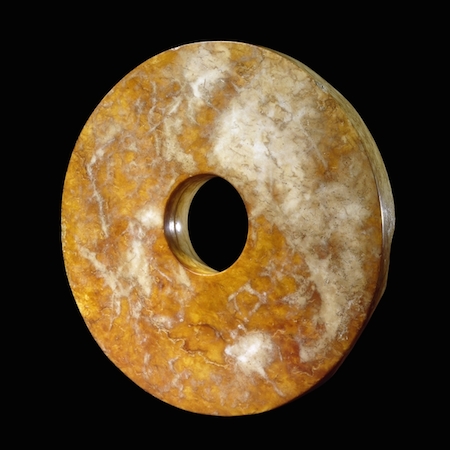
As archeological artifacts of jade were used in a variety of ceremonial and ritual events, including burials, its versatility truly illustrated its uniqueness. Ritual jades were known for taking on several oblong forms, including hoe blades, flat axes, trapezoid blades, and scepter shaped blades. The “ceremonial jade most frequently mentioned in the texts is the kuei, called an oblong tablet, the insignia of the ruler.”[10] While the kuei symbolized the rulers’ right to rule, emperors used it in sacrificial ceremonies to demonstrate homage to the East. The Ts’ung was an early ritual jade that took the form of an eight cornered cubed tube, but was not characterized as a burial jade. Similarly, “Chou Li merely says that with the yellow ts’ung the Emperor pays homage to the Earth, that it is a symbol of authority.”[11] As jade ring discs were distinguished ritual objects, paying homage to heaven, they consisted of three types according to their perforation and width: pi, yuan and boon. While the pi was known for holding utmost importance, the yuan and boon were typically found in tombs.[12] More specific burial jades included mouth amulets, eye covers and other tubes and plugs designated to preserve the deceased. In addition to the mouth amulet serving as a royal gift, royal nobles were gifted with the privilege of being buried with jade shrouds.[13] Jade pendants and amulets symbolized rank as emperors often wore hairpins and jade earrings during offerings made to their ancestors. Pendants were often strung onto ceremonial headgear and courtiers wore girdle ornaments of jade that hung on chains. Holding an akin ornamental significance, “articles of personal use such as seals, garment- and belt-hooks, belt plaques, hat ornaments, garment-rings and jangles, comb-tops, earrings and similar objects” were made of jade.[14]
https://www.khanacademy.org/humanities/art-asia/imperial-china/neolithic-art-china/a/jade-cong-and-bi
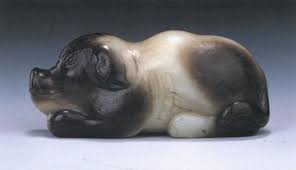
As exhibited in ritual jades, Ts’ung, and ring discs, numerous ceremonial and sacrificial jades demonstrated homage to the natural world or a higher authority. Not only did the exquisite gemstone satisfy the duty to pay respect, but it symbolized high rank, lasting throughout the Han dynasty in oblong wands and tablets, tomb reliefs, and monuments that featured officials with badges. Some jade pendants were “sewn to the bonnet as a sign of rank.”[15] As jade was accepted as a symbol of virtue, jade pendants were known for symbolizing virtue by eradicating thoughts of little significance. Correspondingly, the clanking of courtiers’ girdle ornaments of jade embodied virtue. Because jade was known for its auspicious meaning, it gained widespread recognition as a symbol of prosperity and longevity. While the carving techniques created in the Neolithic period remained unchanged, in the Qing dynasty (1644-1912), “favorite subjects for hardstone carvings were fruits and vegetables, often functioning as rebuses that conveyed wishes for prosperity, longevity, good fortune, perpetuation of a family’s line, or even academic success.”[16] Smaller jade objects were often offered as tokens or gifts amongst friends, seen as spreading good luck. These smaller objects resembled various animals such as birds or fish, as well as deer (lu) which symbolized prosperity.[17] Burial jades were greatly esteemed as they promoted longevity by preserving the dead and combating sickness. It was commonly known that burial jades prevented disintegration and, therefore, “a corpse whose orifices were stopped with jade was not supposed to decay.”[18] For example, the “Stylized pig,” made in the Han Eight Cut style, was from the Eastern Han dynasty.[19] This burial jade, known both for its chiselled surface and great detail, was placed in the hands of the dead in their tombs. The “Stylized pig” fostered a sense of longevity as jade burial suits were “possessed of some magical property, which helped to preserve the body, and this was apparently the reason for the jade burial suits.”[20]Jade also took on a more spiritual meaning through its extensive use of animal motifs. Dating back to the first two millennia of Chinese culture, “jade was thought to be of supernatural origin, an emanation of streams and mountains, something created by the forces of nature, born within the earth and endowed with transcendental qualities.”[21] Confucius further enhanced jades’ symbolism and spirituality, as well as its great virtue and eternal significance.
https://link.springer.com/chapter/10.1007%2F978-1-4615-3922-3_7
For some four thousand years, Chinese jade was held to a “higher esteem than gold or jewels.”[22] Over time, jade was increasingly associated with moral ideas of purity and goodness. While the five virtues established by Hu Shen in 100 A.D. have endured, charity, rectitude, wisdom, courage and equity continue to capture the significant meaning of jade. As a means of providing homage, gift giving, portraying high status, and aspiring for prosperity and longevity, jade’s symbolism was invaluable. Consistent with Confucius’ belief that jade would be used for centuries as the most desired stone, jade continued to “contain the essence of life, virtue, and eternity.”[23] Because of its symbolic and aesthetic worth, as well as its holistic value, jade was a treasure of Chinese culture.
[1] Roger Keverne, “Jade: A Special Gemstone,” in Jade, (New York: Springer Science Business Media, 1991), p. 22.
[2] Ibid.
[3] Ibid., p. 24.
[4] Ibid., p. 20.
[5] Elizabeth Lyons. “Chinese Jades,” Expedition Magazine, Penn Museum, last modified 1978, http://www.penn.museum/sites/expedition/?p=4268.
[6] Ibid.
[7] Roger Keverne, “Han to Song Chinese Jades” in Jade, (New York: Springer Science Business Media, 1991), pp. 114-115.
[8] Ibid., p. 120.
[9] Ibid., p. 114.
[10] Lyons, Expedition Museum.
[11] Ibid.
[12] Ibid.
[13] Ibid.
[14] Keverne, “Han to Song Chinese Jades,” Jade, p. 116.
[15] Lyons, Expedition Museum.
[16] Jason Sun. “Chinese Hardstone Carvings,” Heilbrunn Timeline of Art History, The Metropolitan Museum of Art, last modified 2016, http://www.metmuseum.org/toah/hd/hard/hd_hard.htm.
[17] Lyons, Expedition Museum.
[18] Ibid.
[19] Keverne, “Han to Song Chinese Jades,” Jade, p. 115.
[20] Ibid.
[21] Lyons, Expedition Museum.
[22] Ibid.
[23] Ibid.
Keverne, Roger. Jade. Springer Science Business Media, 1991. https://doi.org/10.1007/978-1-4615-3922-3.
Keverne’s book, specifically “Jade: A Special Gemstone,” “Hang to Song Chinese Jades,” and “The Glorious Age of Chinese Jades,” include insight into the unique characteristics and properties of jade, jade, as well as its scientific nature. By exploring how jade evolved throughout the different dynasties in ancient Chinese history, the book describes specific items of jade that were used for a variety of purposes and held significant cultural and symbolic meaning. Keverne explains how jade was used not only as an item of trade, but also in rituals and burials, as well as in sculptures and personal ornaments. Keverne’s scholarly edition of Jade is very informative as it includes previous research and numerous relevant artifacts. I can use this resource to analyze how the various purposes of jade contribute to its symbolic meaning.
Lyons, .Elizabeth”Chinese Jades” Expedition Magazine 20.3 (1978): n. pag. Expedition Magazine. Penn Museum, 1978 Web. 28 Oct 2020 <http://www.penn.museum/sites/expedition/?p=4268>
Lyons’ expedition illustrates the ornamental use, as well as the religious significance of jade. Lyons traces jade’s origin in history and describes it as supernatural. Lyons brings the reader’s attention to ritual blades, ring discs, burial jades, jewelry and other objects of great importance. Lyons’ fascinating expedition revealed archeological evidence that supports her findings of jade in these valuable objects throughout history. I can use this resource to draw connections to how jade was utilized in different fields.
Sun, Jason. “Chinese Hardstone Carvings.” In Heilbrunn Timeline of Art History. New York: The Metropolitan Museum of Art, 2000–. http://www.metmuseum.org/toah/hd/hard/hd_hard.htm (June 2016)
Sun’s museum expedition explores how jade compared to other exclusive hardstones in the history of China’s materialistic culture. Sun describes the art form of hardstone carving and how the practice allowed for economic growth and prosperity. As he introduces the craftsmen’s work, he highlights the aesthetic purposes, as well as auspicious meaning behind the objects. Sun’s resource consists of a great amount of information provided by the Metropolitan Museum of Art and British Museum, as well as other well regarded pieces of work. I will use the museum expedition to expand my knowledge of this emblematic art form.
