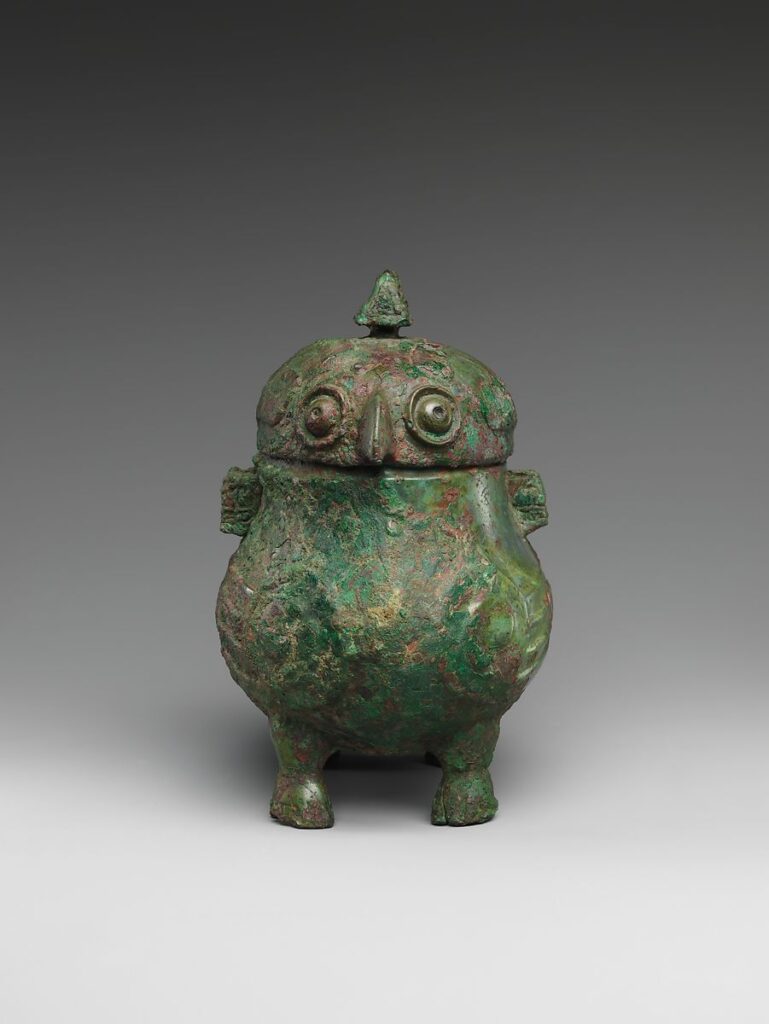
While many cultures are known for performing their own unique rituals, the Shang Dynasty of early China was known for introducing bronze vessels that were produced by artisans in 1600-1050 B.C. (Bensimhon, Rachel). Such precious artifacts were known for their prominent designs consisting of mythical creatures and their ideas were inspired by animal species, as well as new, distinctive creatures. The aesthetic works held numerous interpretations and were known for their diversity.
Not only were the bronze vessels designed for beauty, but they were designed to hold sacred value and for religious practices, as well as for political purposes. The motive of their designs was to “evoke an impression of something otherworldly” (Bensimhon, Rachel). Ancestral sacrifices during the late Shang period cultivated the “technologically sophisticated bronze-casting industry, which was devoted primarily to the production of vessels for the meat, grain, wine, and water used in ancestral sacrifices and ritual weapons, rather than more practical tools” (21). While various religions host ceremonial meals, the bronze vessels are a common ritual that were used in daily life. In addition, one fact that I found particularly intriguing was that humans were incorporated in the taotie motif. This makes me wonder if humans were physically sacrificed?
Furthermore, technology had an important impact in assisting the advancement of the designs of the bronze vessels. It allowed for them to be “consistently adorned with a two-eyed zoomorph, traditionally called the taotie” (22). As the taotie motif was produced in a significant amount of military equipment, as well as instruments and stone mortuary furniture, “the ritual function of the artifact rather than the medium in which it is made determined whether the taotie was an appropriate form of decoration” (27).
I found it very interesting learning about such precious artifacts that held such a historical significance in ancient times. I am curious to further investigate how the bronze vessels evolved over time and were incorporated into many ritual functions.
Works Cited
Bensimhon, Rachel. “Precious Metals: Animal-Shaped Bronze Vessels in the Shang-Dynasty Period.” In People and Their Stuff: A History of China in Objects Now Preserved in North America. URL: http://scalar.tdh.bergbuilds.domains/hst137/precious-metals-animal-shaped-bronze-vessels-in-the-shang-dynasty-period
Ledderose, Lothar. “Casting Bronze the Complicated Way” Chapter 2 in Ten Thousand Things: Module and Mass Production in Chinese Art. The A.W. Mellon Lectures in the Fine Arts, 1998. Princeton, NJ: Princeton University Press, 2000.
Allan, Sarah. “The Taotie Motif on Early Chinese Ritual Bronzes.” In The Zoomorphic Imagination in Chinese Art and Culture, edited by Jerome Silbergeld and Eugene Yuejin Wang. Honolulu: University of Hawaiʻi Press, 2016.
