The Summer Palace and the Forbidden City are essential monuments that serve a great significance on Chinese history. The Summer Palace was originally known as Yuanmingyuan and was built in the early 18th century. Yuangmingyuan was considered an individual garden, as well as a complex of combined gardens. While the main focus of the gardens consisted of their hills and lakes, there were also buildings featured in the landscape which “[were] designed to resemble scenes from the Jiangnan region, or Lower Yangzi Valley, from which China’s famous literati poets and painters hailed” (Li). As the emperors utilized the Summer Palace as a place of residence, ““Yuanmingyuan was [known as] a paradise on earth for the Qing emperors.” Yuangmingyuan can be translated in Mandarin characters as the “round (yuan 園) and bright (ming 明) garden (yuan 園)—or the Garden of Perfect Brightness” (Li). The Yongzheng emperor was responsible for expanding upon the garden. He left an additional garden, the Garden of Joyful Spring, to his mother. His son, Qianlong, added a third garden to the complex known as the Garden of Elegant Spring. The three gardens were eventually united to become Yuangmingyuan.
It is known that “Yuanmingyuan was at first a scenic retreat for the emperors who wished to escape the heat and formal obligations of the Forbidden City in Beijing” (Li). The Forbidden City took four years to build and is 720,000 square metres. The “Forbidden City complex was the beating heart of Beijing” (Hernandez). It consists of various materials, such as stones and timber. As the Forbidden City was known for hosting ceremonies for the imperial family, its reception halls can be found in the front, while the complexes located in the back consist of where the imperial family was housed. Entry into the Forbidden City was strictly restricted. It turned out that the “imperial system collapsed at the start of the 20th century and the Forbidden City, which had been home to emperors since 1420 and housed the world’s greatest collection of art treasures, was turned over to the public and transformed into the Palace Museum” (Arranz). Today, the fascinating Forbidden City is known as a national museum.
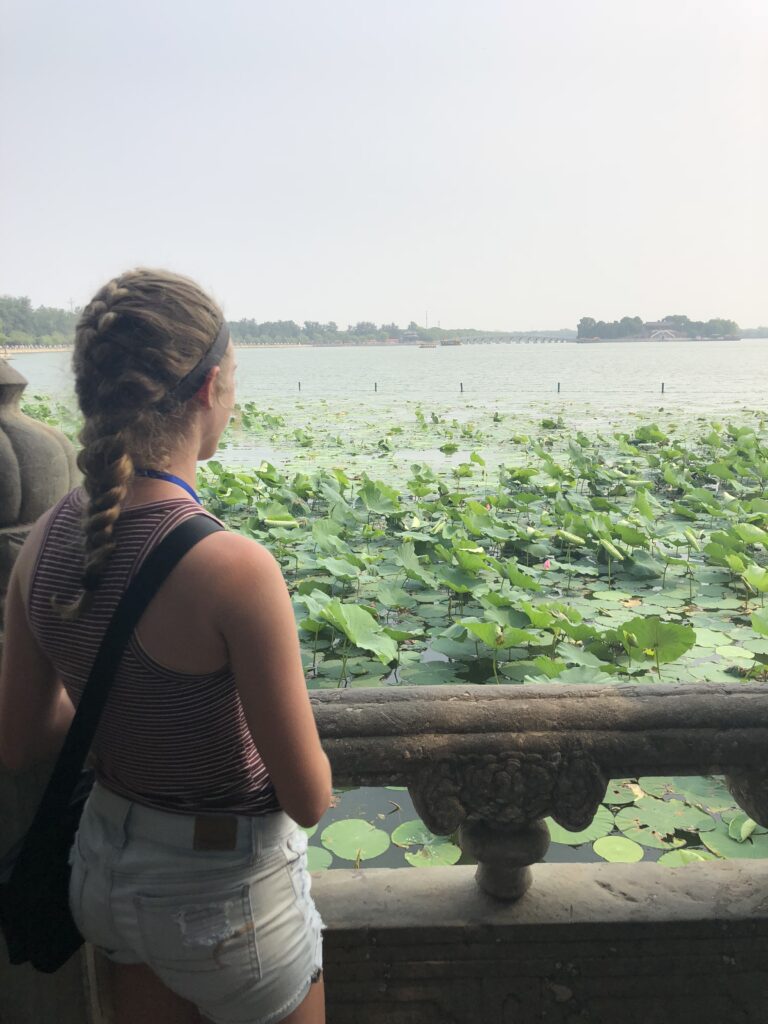
Author: Paige Goldberg (Original Photo)
Works Cited
Li, Lilian M. “The Garden of Perfect Brightness.” MIT Visualizing Cultures, 2012.
Hernandez, Marco. “The Origins of Beijing’s Forbidden City.” South China Morning Post. May 29, 2018. https://multimedia.scmp.com/culture/article/forbidden-city/architecture/chapter_01.html?src=follow-chapter
Arranz, Adolfo. “How China’s Forbidden City Became the Palace Museum.” South China Morning Post. December 05, 2018
